Tuesday, October 20, 2009

How Often Does Someone With Hiv Get Sick

Abelard in Seine-et-Marne or the heritage of a historic mistake or Relics

J.-A. Benouville table entitled "Abelard talking to his students near Melun, 1837, Pinakothek in Munich


If we hear most often by a common heritage or monuments department, it can also take a more intangible such as language, music, culture and links with prominent figure in history. Also, beyond the buildings, it is common to associate a city or village with a character whose past will fall upon the streets he once walked. Thus we will link La Fontaine at Chateau-Thierry, Meaux Bossuet or Gaston Phoebus in Foix.
links between Peter Abelard's intellectual early twelfth century, famous for its history with Heloise and Seine-et-Marne are many. Of course talk of the Seine-et-Marne for a character in the twelfth century did not make much sense but at least two cities can boast of having hosted the brilliant thinker. First Melun, then in the royal domain, where Abelard moved as a teacher in 1102 before Corbeil then moving on to return in 1109 after many vicissitudes. Perhaps that the choice of the name of the library of the city (known as the Astrolabe) is no stranger to this historical fact puisqu'Astrolabe is also the name of the son of Abelard and Heloise. The second city could be Provins (then in the county of Champagne) in which Abelard took refuge after his flight from the Abbey of St. Denis in 1122, shortly before founding the Paraclete. If the two cities have a street dedicated to Abelard, however, be noted that neither the one nor the other does make a massive celebration: on the website of the Mayor of Melun it is mentioned in a list of writers who have stayed in the city while the site of Provins does not even quote. Note, however, that his presence here is posted on the site of the departmental archives of Seine-et-Marne in the "local Figures.
is curiously a small village between Meaux and Coulommiers Maisoncelles-en-Brie, which seeks to register as Peter Abelard in his heritage. It all began in 1845 with the publication by Charles de Remusat the first biography of Abelard and a note that the author slips on a passage from his autobiography ( The story of my misfortunes ) Could not be more vague . In 1120, Abelard, then a monk at the Abbey of Saint-Denis, moved out of the monastery to resume his education. Himself said: "I finally retire to a sanctuary ( ad cellam quamdam , sometimes translated as" priory "or as" monk's cell) and resumed my teaching habits. My classes attracted such a crowd of students that fail to place the house and land to feed them. "Later he says that this place was on the lands of Count Theobald (so in Champagne). The original and contemporary sources do not say more about this place of education. In his text, Charles Remusat resumed identification made - without explanation - by the editor of Volume XIV Series Historians Gallic containing the story of Abelard. Following the words "ad quamdam cella", he inserts a note containing a word: "Maisoncelle" without qualification. Remusat therefore used for his book but not without suspicion
"D. Brial only said that this place is Maisoncelle. There is in the department of Seine-et-Marne several villages of that name. The place where Abelard lived [...] may or Maisoncelle borough and township of Coulsdon, or rather Maisoncelles Township Villiers-Saint-Georges in the arrondissement of Provins "(NB. auj. in the town of Saint-Martin-du-Bochet).
We see clearly that this is an assumption that does not completely convinces Remusat and it prefers to place located near Provins, that is to say closer to the Count of Champagne, which has established itself as protector of Abelard. Here we see the little consideration that the historian may grant the proposed identification: the word "cella" of the original text being found in the place name and Maisoncelles Maisoncelles originally belonging to the abbey of Saint-Denis, it was concluded that Abelard had stayed The ... wire is thin but tenacious especially when a scholar of the late nineteenth century, Gabriel's Chaffault, publishes a book entitled Mesoncelles-en-Brie, a dependency of the abbey of Saint-Denis - Abelard and Heloise (1894). Taking the assumption that his writing is no longer one of his two predecessors, it links the village to the final figure of Abelard in the only monograph devoted to the town.
However, for any specialist that time, the error is gross. On the one hand the link between the Latin word used by Abelard (which actually refers to a dwelling place of religion in a broad sense) and name of the village can not be a tangible proof. In addition, Peter Abelard in the same passage says that the success of its reduced during "those of all other teachers," meaning that it is so close (or in) a city with several teachers, what does is probably not the case of a village in rural Brie. It is for this reason that historians of the twelfth century as Michael Clanchy and John Benton prefer to imagine a place close to Paris or around Nogent-sur-Seine (for explanation see: M. Clanchy, Abelard, Paris, 2000, p. 284). Add to this a compelling argument related the local context: Maisoncelles occurs at this period in the forest of Le Mans, Meaux between forest and Coulommiers now virtually disappeared. This is also from here that the locality takes its name: the "Home" Maisoncelles, as for the nearby town of Upper House, indeed refers to the name of the forest of Le Mans. However, this forest is cleared only from the thirteenth century. It was around 1220-1230 that the parish of Upper House for example is created. It's the same for Maisoncelles. Until now the monks of St. Denis had the rights over a portion of the forest and clearing allows the emergence of new village communities (Including revenue sharing is negotiated, as evidenced by the few charters cartulary of the cathedral chapter of Meaux). We can therefore say with certainty that no Maisoncelles early twelfth century Abelard and therefore could not settle there with his students. For the historian, he must resolve to some hypotheses that remain uncertain ...
Yes, but here, the books and Remusat Chaffault have their effect. The village of Maisoncelles is now widely associated with Peter Abelard: there is such a "street Castle of Abelard and Heloise" (as legend has it that the two lovers there are located), and a retirement home "Heloise and Abelard." In October 2009, the municipality has even opened the new school under the patronage of 'Peter Abelard. " The website of the Mayor spends a long page the general character, even specifying them wrote letters Abelard to Heloise!
It is well here against the heritage of a historic mistake. For the common Maisoncelles highlights a character who has probably never set foot on its territory. We may, from this case, reflect on the current role of the historian. The art historian is made of assumptions that need to explore, confirm or deny. However, the public expects the historian a link between the present and the past, a solid foundation for the establishment of a tradition, a heritage, a memory. Admittedly, the historian can not change its working methods. By cons, it is important to explain to the uninitiated how we make history and to understand the hypothetical part of this human science.
To conclude the adventures of Peter Abelard in Seine-et-Marne, I would point out another phenomenon. Indeed, the presence of Abelard to Maisoncelles revealed by the book by Gabriel Chaffault seems to have penetrated a little in the oral tradition of the surrounding communities. I recently read notes left by an amateur historian and folklorist, Gerard Mourlet, who worked on the village of Quincy-Voisins in the 60s. Here's what he reports: "Mrs. D. .. Germaine tells us that the Cross would Segy put on the very site of a convent and Abelard would come to rest." Segy is a hamlet in Quincy-Voisins, a town situated about ten kilometers from Maisoncelles. There never was a monastery there and it is highly unlikely that the husband of Heloise has come to stay but that note, however, prevents patrimonialization a future ...

Thursday, October 15, 2009

Indian Free Satellite Channel Frequency

Ashes?

Scene of devotion at the tomb of Mother Teresa in Calcutta (India)


Last week, the Albanian Prime Minister Sali Berisha announced that his government had formally requested his Indian counterpart the repatriation of the ashes of Mother Teresa, beatified nun, born in Macedonia is ethnically Albanian, which we must celebrate the centenary of the birth in August 2010. At the same time, Albania has also petitioned the same nature of the French government to consider returning the body of King Zog I, buried in France in the Parisian cemetery of Thiais. The return of the remains of these two characters is part of the arrangement of an Albanian national pantheon. King Zog, long discredited by the communist regime, is now seen as the modernizing of the Albanian state. As for Mother Teresa, whose ashes are also claimed by Macedonia, it is in the nationalist discourse, the symbol of tolerance built into the Albanian national character. She is also the personality of the most famous Albanian of the twentieth century. Symbolically, it is already very active in the Albanian territory: in addition to the hospital and Mother Teresa Mother Teresa Square outside the University of Tirana, it really gave his name to the international airport of Rinas, thus displaying the strong bond between her and Albania . or rather between Albania and in claiming the body of Mother Teresa, Sali Berisha definitely intends to nationalize the nun of Calcutta, with an even greater interest that several Balkan countries argue its origin.
The Indian government's reaction was swift. Tuesday, October 12, the spokesman for the Indian Foreign Ministry said: "Mother Teresa was a citizen of India and is based in his own country, his own land, "adding that the question of his return to Albania" does not even arise. "Indeed, Mother Teresa had in 1951 obtained Indian citizenship and lived the rest of his life in Calcutta, where she founded her order of Missionaries of Charity. It is also known worldwide as "Mother Teresa of Calcutta" even if the promoters Albanian identity often nicknamed "Mother Teresa of Albanians." Sali Berisha meanwhile believes that the issue remains open and that both countries need to discuss it. He also reiterated his wish, saying "it would quieter than anywhere else if she could sit next to his mother and sister "buried in Tirana, pulling on both sentimental and a rope on the idea that the family is the foundation of the Albanian nation. It is clear that India's response will not change but the speech of Sali Berisha it is sent to India or Albanian? The prime minister seems to keen to encourage the patriotism of his countrymen. Therefore the concomitant Both applications would signal a willingness to provide support to a national fervor.
But it also seems that Sali Berisha has not really understood the implications of what he asked. I have shown elsewhere that the secular neutrality of the Albanian state, covered by a speech of interfaith tolerance, gum any aspect of sacred religious issues just to keep a domestic gasoline entering an address above unity of the Catholic, Orthodox or Muslim. Now, caught in the straitjacket of ideology, he has forgotten the religious nature of his complaint. For, in seeking the return of the ashes of Mother Teresa in Albania, he does not claim the body of a national hero but the body of a nun beatified whose remains have the status of relics in the eyes of the whole Catholic. Significantly, he finds himself, at the same time that the Indian government's response, it was reported by the spokesman of the Missionaries of Charity, the order founded by Mother Teresa, who retains his grave as an offering to the veneration, n ' had not even been asked by the Albanian government. In keeping with the logic of a nationalist discourse, Sali Berisha has not considered the Catholic identity of her whose ashes he claims.
The crucial question is concerning: the tomb of Mother Teresa it contains the ashes or relics? A non-Catholic (atheist or of another faith) would answer that this is a Catholic but his ashes speak here of his relics. And this is how the Missionaries of Charity to consider. If one visits the site of the Centre Mother Teresa of Calcutta, there is a page titled "Relics" which explains precisely what the relics and the statute made by the body after the beatification of the nun. It even explains the procedure to follow to receive a relic of Mother Teresa. Perhaps the Albanian government should have tried a request to the email address shown ...
More broadly arises here the question of borders between world views or "programs of truth" in the words of Paul Veyne. For some, Mother Teresa is a national figure, for others beatified a nun whose expected canonization. For the former, the grave contains the ashes dedicated to civic and national fervor, for the latter, his tomb is a shrine containing the relics of the first category, that is to say, the bodily relics. For Sali Berisha, we talk of repatriation (literally back to the homeland) for the Church, it would be a translation of relics that might alleviate the burden of sacred sanctuary of Calcutta. The situation is this: in the midst of a grave and the discussion around it interlocutors who do not speak the same thing ...

Creative Sound Blaster Audigy Se Jack

History of Migration in Ile-de-France

The Federation of Historical and Archaeological Societies of Paris and the Ile-de-France organizes on 27 and 28 November 2009 the thirteenth conference of regional history with the theme "History of Migration in Ile-de-France "to be held in Créteil Hotel Department.
I for my part would participate in one of my ongoing research on Albanian immigration in France in the inter-war period. Paris is indeed a major site that I have identified with the North of France, Saint-Etienne and Lyon. My paper focus on the Albanian question in the capital and the surrounding communities (including Saint-Ouen and Clichy). From the Archives holdings of Paris (censuses, administrative records and judicial), the Archives of the Prefecture de Police de Paris (the term "colony Albanian" was derived), private funds from the National Archives and memories Albanian migrants published in Albanian or French, I will try at first to identify the different categories of migrants (students, political exiles, and labor), the privileged areas for installation ( Latin Quarter, neighborhoods north of Paris, Saint- Ouen), their places of sociability and how they organize (associations) or not to organize. It is also understood that first wave of emigration from this young country (Albania being independent since 1913) in which the Albanian communist movement took birth in part through working with personalities such as Albanian workers Halim Xhelo. From the perspective of Parisian history, it is interesting to look through a magnifying glass that can be a community of migrants, rather small (between 300 and 500) and examine the concept of community group (is he joined a group or is that the strata are only found never? And how?), Especially since this "group" barely survives the war (back in the country, unable to renewal of migrants because of the dictatorship).

I give you here the two-day program:

Program

Friday, November 27, 2009
14h: Home
methodological approaches to migration
14h15: Philippe Rygiel, "Overview on the historiography of migration"
2:45 p.m. Delphine FOLLIET " www.generiques.org : online resources for the history of immigration"
15.15: Stéphanie Rivoire, "the collection of audiovisual archives on Migration in Val-de- Marne

International migration, internal migration
16h: Christine GARMY, "Immigration, internal migration and external Nemours eighteenth century to the present"
16.30 CAZEIN Mary, "migratory movements Louvres the middle of the eighteenth century to the Second World War "
17h: NICOLSKY Alexander," The Russians Chelles (1914-2009) "
17.30 ATALIAN Claude," The immigration of Armenians in the Ile-de-France "
18h: François Boulet," The exodus from May to June 1940 in Ile-de France "

Saturday, November 28, 2009
International migration, internal migration (continued)
9:30 Natacha Lillo," Immigration in Seine-Saint-Denis and Hauts-de-Seine "
10h: Nancy Green," An immigration elite: Americans of the right bank (1880-1940) "
10.30: Marie-Claude Blanc-Chaléard," The Italian territories in the Paris region (1880-1960) "
11.15: Marie-Christine Volovitch-TAVARES," The Portuguese presence in the Ile-de-France "
11:45: Mick WILMART," The 'Albanian colony' in Paris in Between the Wars "

reception, integration of migrants
14h: Marie-Denise VIGNAL," Successful integration: the Swiss at Rueil in the seventeenth and eighteenth centuries "
14h30: Michel Guillot, "The patronage of the Little Savoyards and hermitages in the Paris region in the eighteenth century"
15h: Janine Ponty, "Paris, second capital of Poland"
15:30: Daniel Martin, "A shanty town on the Portuguese shelf Champigny"
16:15: Sevan Ananian, "The mutual integration of Armenians in Alford"
16h45: Thierry Halay, "Esperanto and lesmigrations in Ile-de-France"
17:15: Pascal Gauthier, "The Odyssey 'Esparisiens' in the second half of the twentieth century"
17h45: Andrew Cohen, "The arrival of Jews from Egypt to France (1948-1956)"
18h15: Philippe Rygiel, "Conclusions"

Wednesday, October 7, 2009

Thermocol - Polystyriline

14/20: Rondot splashes Villepin

is still crazy. In this nauseating Clearstream affair (and not very important in itself, I grant you), General Philippe Rondot, who has taken - his oath, former boss of the DGSE (Secret Service, which means that it is far from being a "weathervane" as seems to be Gergorin) seems not to be taken seriously by Villepin, who loses his cool.

"The scene is Pretties. The presiding judge has before him, lined up as if on parade, the three main defendants in the trial and its great witness, General Rondot. Confrontation. The words rang out. Word of Minister cons verbatim general.

Villepin displays a half-smile. Gergorin pouted. Lahoud played man finally free from his lies. As for the general, stiff neck, he does not let anything pass. " I have no reason to invent. I'm not a snake charmed by a flute player " he let go with one of the lawyers of Dominique de Villepin, who remained speechless.

Heart of the interrogation of the day: the custody of Imad Lahoud, March 25, 2004. Is the minister intervened to get him released? " Our source is in custody ," he reportedly announced Gergorin. Villepin denies. " I do not take it to the phone. " Annoyed, the man EADS maintains. First hitch for Villepin. That day, the then Minister of Foreign Affairs, he is heading for Brussels and a meeting on the Madrid bombings. He calls Rondot, a specialist in Islamist terrorism. Then after a few words on the subject (Rondot version), Villepin said: " Make release the source! " under Lahoud heard."

Read more in western France

Saturday, October 3, 2009

What Lenghato Wear To ?

0 / 20: absolve Polansky, one wonders why?

Oh, they raged our "bobos" artists (to Luc Besson, who had the courage take place).

"Free Polanski, they swamp us," his arrest is an outrage, it's a great man, the girl has forgiven him ... "It boggles

. Polansky, guilty of raping a minor of 13 years, having fled the United States at the time not to end up in jail, should escape justice? Oh, and why?

"On Thursday, Culture Minister also explained the reasons for his massive and immediate support to the director, from his arrest last Sunday Switzerland . He said that the actions of the director were "serious, not excusable," and should "be punished", and getting back on the same line as the government, which reiterated Wednesday that the charges against Polanski were serious, and that the director was not "above the law," but not "under law" either. Then Frederic Mitterrand said: "It is the role of the Minister of Culture to defend the artists [...] As a French citizen and a major artist, Roman Polanski deserves the French minister of culture is supportive and compassionate, I think ".

Polanski was arrested in 1977 and accused of providing drugs and alcohol to a minor, before having sex with her illegal. He then said that this was not the first sexual experience of adolescent age in the age of 13 years, and she was consenting. Released on bail before his trial in 1978, he fled the United States, fearing an award of up to 50 years in prison, and never set foot ... "Read

here and 20 Minutes

Thursday, October 1, 2009

Precision Engineered Creatine Instructions

Anthropology historical relics

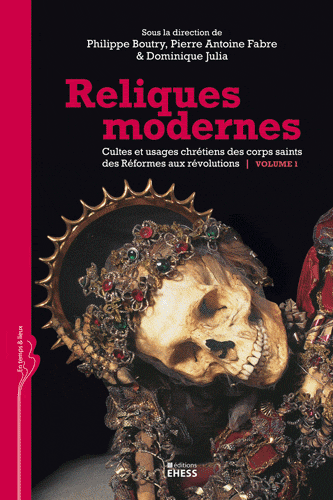
modern relics. Christian cults and customs bodies of saints Reforms revolutions , edited by Philippe Boutry, Pierre Fabre Antoine Dominique Julia, Paris, Editions de l'EHESS, 2009, 2 vols., 903 p.

These two volumes are the result of a collaborative investigation conducted within the Centre of European religious anthropology for several years. He was wondering about the religious significance, cultural and political relics. Far concentrated on the medieval period, the history of relics is proposed is part of the modern era, showing the continuity of their revered (and controversies related) over a long period.
With the radical critique developed by Calvin extending the doubts of the humanists of the early sixteenth century, the modern period opens for the relics of a controversy that did in fact never closed, which discusses not only the authenticity of the same relics but also the justification of their faith.
Crossing the centuries, I can not resist to quote here an excerpt from d iscussion of the article "Relic" Wikipedia:

Relics
... And no one to suggest the boundless stupidity of such superstitions!? The jar of Cana, the Roman soldier's lance, the prepuce of Jesus ... And then what? The marriage of the Virgin, no doubt? That would be to roll over laughing if he was at the bottom so sad and shocking to see how religious leaders focus their flocks, to themselves and their myths and their tall tales, as dogs at sausages! Ignorance makes gullible, gullibility makes stupid. J.Ph.CH

Development
It is not so much in these articles, to justify the existence or authenticity of these relics (...) to study their religion, their veneration ... The purpose of these studies is essentially from the history of mentalities (it is well worth the battles). Let us not forget that the worship of relics, like many other superstitions, has influenced the lives and deaths of many people over the centuries. Why hide under the guise of rationalism? I myself am an atheist and a skeptic, but also a historian. And a little humor and derision never harmed even in a serious encyclopedia ... Daniel71953 August 13, 2007 at 15:16 (EST) Received

5 / 5 and of course, totally agree with this attitude, but perhaps, after all, should you distance yourself a little more, you a little more ... say ironic that you think of the children read: do not you hear by asking their teacher if it is true that we have found and kept the nails of the cross of Jesus, or perhaps - why not? - A wing feather of the angel Gabriel? "Sir, I read on Wikipedia that etc.. Etc ..." :-) J.Ph.CH


SUMMARY

VOLUME 1
Foreword
Part. Places and bodies of saints: the time for polemics
Pierre Antoine Fabre, Mickaël Wilmart, The Treaty of relics of John Calvin (1543). Text and context
Dominique Julia, The post-Tridentine Church and relics. Tradition controversy and criticism (XVI-XVIII e th century)

Philippe Boutry, A sacred charge. Restoring relics and renewal of controversy in France in the nineteenth century e
Alain Cantillon Healing a child in 1656 at Port-Royal de Paris. Archives, miracle and relic
Nicole Courtine Plancy Collin (1794-1881) and Critical Dictionary of relics and miraculous images modern relics

Part II. The power and the sacred
Mario Rosa, The belt of the Virgin in Prato. Of "civic religion" to the "enlightened piety"
Francoise Le Hénand, The translation of relics in France in the seventeenth century e
Guy Lazure, Own sacred. Monarchy and Identity in the collection relics of Philip II at El Escorial
András Zempleni, The phantom limb of the mystical body of the founding king. The right hand of Stephen I st and space Hungarian National

VOLUME 2
Third Party. The Sacred in the war
Denis Crouzet, On the disenchantment of the holy bodies troubled times of Religion
Baciocchi Stéphane Dominique Julia, and Relics French Revolution (1789-1804)

Bernard Marchadier, The exhumation of the relics in the early years of Soviet power

Part Four. Inventories and inventions places
Pedro Cordoba New Foundation. About false relics Sacromonte Granada
Catherine Mayor France, land of holiness. At About The Topography of Saints Adrien Baillet

Antoine Pierre Fabre The great reliquary in the chapel of the Crucifix. Research on the cult of relics in the church of San Ignazio, XVI-XIX e e centuries

Part Five. An expanding area
Ines G. Županov, A shrine city: São Tomé de Meliapor. Politics and the sacred in Portuguese India in the sixteenth century e
Leandro Karnal Relics in the conquest of the Luso-English America
Charlotte de Castelnau-L'Estoile, sharing relics. Tupinamba
face and Jesuit missionary to the bones of shaman (Brazil, early seventeenth century e)


Part VI. Relics and reliquaries: An Archaeology of the sacred
Muriel Clair Body and decoration. The Native American relics in the chapel in New France in the seventeenth century e
Yves Gagneux, between religion and history. The shrine of the tomb of St. Genevieve
Saint-Etienne-du-Mont

Muriel Pic The future image of the relic in the era of mechanical reproduction.
Photography, copy and metaphor


Bibliography - Index