Wednesday, December 23, 2009

Do I Have Stomach Flu Or Stress

ban the veil and women's liberation

A Catholic woman veiled in Shkodra (Albania) photographed by Kel Marubi early twentieth century

The law proposal of Jean-Francois Cope to ban the wearing of the burka in public space historian recalls other experiences that we probably did not draw all the lessons.
Thus, Albania between the two world wars has also had its law banning the full veil. In August 1929 the Government of Ahmet Zogu took this decision after a proposal by the head of the Muslim community who then judge the custom contrary to civic education.
First act of emancipation of Muslim women? The writer Migjeni contemporary facts, gives us behind the scenes in his novel, entitled "It reopens the gates ..." (Translated into French and published in Chronicles of a northern city , Paris, Fayard, 1990, p. 215-225). He describes the reaction of the people of his city, Shkodra, located in northern Albania:

The house was plunged into silence. it reigns like an atmosphere of agony. Yes, it is an agony that is, without distress. In hundreds and hundreds of other homes like this, a secular past, so deeply felt and lived by all, is dying. It removes the cornerstone of the citadel millennium and many hearts are torn to see collapse. Others, instead, rejoice as if we had brought down some monstrous beast bane of the existence of each. The headline of the newspaper, this reform, the abolition of the veil among women as a sarabande form of evil spirits who come to torment the brains numb, unaccustomed to design such things. So far only bothered with little or family concerns most prosaic Here are the heads suddenly haunted by a concern that affects everyone, by a collective problem, and owners of these heads are found like fish on the beach. Remove the veil on women: no one had ever thought to see it in his lifetime.
The real shock is described in men and women. Especially among men, afraid to know their women exposed to the gaze of other men. Among women, Migjeni describes feelings more mixed, some were happy, others are more mixed or even opposite.
Two days before the implementation of the ban, followed by family the narrator meets that men can "see their relatives one last time, because God knows when they would be given them again!". Because men do not intend to oppose the law. But they did not intend to leave their wives and daughters out into the street without a veil. And that's where Migjeni fly in this new fact: While the headscarf ban, but with what consequences for women? That of not being able to leave the private space, chosen by men as an insult considering letting walk the streets their wives bare heads. And men to get out in the tale of a new tip Migjeni : Reopen the gates between the backyards of houses (not visible to the street) to let the women go from house to house without going on the highway ...
Arguing the headscarf ban by the desire to liberate women from this example seems a possible error. Because nothing says they let women out, we now require to wear the full veil, once it is forbidden ...
If wearing the burka may seem shocking to many is probably the republican system to respond by winning his own authority, without law, but only by the only force that can model propose ...

Monday, December 21, 2009

Squash Balls Colour Coding Meaning

REVIEW COPY 2009

That the season is finished schooling

competitions have passed and the birds have found

more spacious cages.

Since late September they were housed in cages of schooling

not obvious to stretch their wings, they all worked well

Result of the first contest to Wardreck

a first male finished second

finished 3rd and 2nd

my stam and all other n have not sung

poor preparation? Stress?

causes may be multiple

Before the championship of France I have trained

even more, I penais same with me

work accustom them to move, to be transported

for which they are constantly changing place that

it is no longer a source of stress for them

all this work finally paid

Championship in Lisieux France

n my stam who had not finished singing champion

d in'm super proud

other results were a bit disappointing

but this is not serious now I know what my birds are worth

and j I learned a lot about how to make a good schooling

Monday, December 14, 2009

Star Tattoo Tom Delonge

The balance of evidence he passes by their removal ?

Displays Swedish photographed in Gothenburg in 2009. Advertising campaign organized by atheists during which the symbols of the monotheistic religions are shown to be interchangeable on the national flag and rendered obsolete by the phrase: "God probably does not exist." (Ratexla - Flickr)

No doubt this question has attempted to meet a Belgian Socialist Senator proposing a law to strictly enforce the separation of state and churches Belgium. Written In 2007, the project would go before the Commission on Institutional Affairs on October 10 but the matter was postponed and referred to Audience Interculturality . These are a space for dialogue created by the government engaged in thinking about improving conditions for the success of a society based on diversity, so space for dialogue in which the debate is not that of national identity but of how to live together in a world that has become multicultural.
Within this framework for thinking about the need intercultural approach the legislation proposed by Philip Mahoux. The postponement of consideration of the project is certainly linked to the controversy it has generated and the Belgian press has simplified grading on ban crosses in cemeteries . Article 6 of the bill specifies that

No real or personal property assigned to a public utility shall not contain or be adorned with signs or any object characteristics of a religious or philosophical concept.
This provision does not apply to signs or exhibits in museums and exhibitions or embedded in monuments and sites.
Disappearance of any distinguishing can be likened to a breach of state neutrality in religious or philosophical, that is the essence of this article, the intention is presented in the comments justifying the project:
This translates in the facts, the principle of neutrality of public service, which can not, by its conduct, nor by any outward manifestation whatsoever to identify with a religion or a philosophical concept.
[...]
Regarding Cemeteries, Article 4 does not prejudice the right of the holders of concessions (private) to decorate for any signs or philosophical or religious purpose. The owner or operator of public remains bound by the requirements of Article 4, that is to say, to observe complete neutrality. It is therefore forbidden to adorn the public areas of the cemetery signs or other article characteristics of a religious or philosophical concept.
For Belgian senator behind the initiative, neutrality therefore requires the absence of a sign: that the state does not display a preference, it does not show it. With regard to cemeteries, since it is the example that has raised controversy, the institutions should not not display any distinctive signs in public areas as may be the case in the middle of the cross aisles. Recall that usually distinguished in cemeteries Public and private parties that are allocated to the family graves of the dead for the time of the concession. It is therefore not here to ban all cross cemeteries - as has been hinted the press and some politicians - but to prohibit any distinguishing features in the parts within the community and in the name of a fine line between religious and philosophical trends.
While in France, in the debate on identity National Nicolas Sarkozy calls believers to "avoid any ostentatious practice", particularly Muslims to refrain from doing "anything that might seem like a challenge" to the legacy of Christian civilization, Belgium Senator Philippe Mahoux reflects the strengthening of state neutrality by removing all religious symbols in public services. For him, integration is through a non-differentiation of public space in the name of respect for the opinions of others. Interculturalism would thus at the very spot where the differences fade and disappear from the public sphere and confine themselves to private. For him, no Christian heritage, but only a society in transformation (or already transformed) based not on past but on this build.
The controversy surrounding the text is probably indicative of an anxiety: that of losing precisely this Christian heritage that emphasizes the French president. It is also this anxiety that pushed the Swiss to vote on minaret ban: they feared that the visible sign of the Muslim place of worship invade their landscape of towers, the symbol of Christianity. Fear of upheaval also sound : And if we made from the minaret call to prayer, it not only cover the sound of bells? The religious heritage is not the only issue: there is also the wish to keep intact a visual and aural landscape that would be characteristic of European societies.
Three positions are then considered: the failure to change, rebalance the landscape by removing signs or finding a compromise between states, ancient religions, new religions and unbelief.
Everything here is a matter of identity, to use a word that does pose problems for social scientists. Because identity is moving definition: individual or collective, it is constantly evolving, at the option of "programs of truth" Dear Paul Veyne. I can be a Christian today, atheist earlier and convert me to Buddhism tomorrow change country in a week, integrate myself fully, defend political ideas different from those inherited from my parents. It all depends on what I believe to be true at a time "t" in my background, the evolution of my knowledge (intellectual and personal), my social environment or national level. Set in France's Christian heritage there a sense after the de-Christianization, the assertion of a secular republic in which freedom of conscience can change religion, the advent of new religions (such as the New Age movement) or previously known alien religions (Buddhism, Islam)? To be French or Belgian have the same meaning for us today, in a society open to the world and largely globalized, as our grandparents witnessed the heartbreak that was the second world war? We see from these questions the difficulties posed by the very question of identity.
But it is probably not the explanation of relevant controversies and tensions over religious symbols. It seems to me that the concept of habitus as Bourdieu has developed could help to understand their springs without going into the discussion of identity in which the researcher can only lose but to say he just does there is no identity. The social experience of the individual product and a set of rules influence both on his actions and perceptions. Perceptions of the landscape come naturally in this scheme. The argument of a common Christian culture of Europe is indeed the result of a social experience that combines the permanent vision of towers, Christmas parties, the names of the calendar, etc.., All lived as a historical legacy. The construction of this habit is even more complex when one adds the spiritual question. We can now call himself a Christian but does not go to church and open to Buddhism both in his experience, his affinity or external influences (education, media). However, the arrival of new elements in the landscape can disturb the habits and cause rejection. This is clearly the case in the referendum to ban minarets in which the populist party led to the initiative stood a portrait of a Swiss landscape suddenly transformed by the explosion of the supposed Construction mosques. Similarly in Belgium, is the article on the removal of signs, and essentially makes the explanation of this with an example the cross cemetery, which has caused controversy: So what would look like without cemeteries cross? Even though he was never to touch the cross graves ... Again, possible rupture of a habit in the cemetery which is identifiable by the cross.
However, the habit is by definition not something fixed. Result of social experience, it develops throughout life, meetings or work done by the individual over himself. It the compromise is somewhere between an inheritance (class, culture, family ...) and development (personal, social). This allows for example the integration to a new environment or the acceptance of differences and novelties. This is certainly the notion that lets take a step back to more current debates ...

Tuesday, December 8, 2009

Best Gay Cruise Spots In South Florida

perception of religion in the contemporary urban landscape

The recent referendum in Switzerland on the Prohibition of the construction of minarets not only raises the question of intolerance shown towards Islam's also the question of the place of religion in the architectural landscape.
Indeed, we perceive the landscape and we read through the key benchmarks that guide us in the urban or rural according to a culture acquired in childhood. Thus, it is recognized almost immediately by a town hall its place, its facade where the national flag fleet and where you can usually read the motto "Liberty, Equality, Fraternity" etc.. From a glance, it identifies the public building and is perceived as the presence of the Republic in all municipalities. One can also wonder how we perceive the religious landscape. Believer or atheist, practicing or not, an ardent defender of secularism or not, all we still know religious building, even though, according to our sensibilities, we can see a shelter or a part of our heritage. For the most part, the churches - if we take the example of Catholic buildings - are patrimonialisées despite the continuity of parish activities. In villages, they are so generally the oldest building, immediately recognizable for its architecture and the surrounding places.
In the urban context, the issue is more complex. Regardless of the age and the monumentality of the church immediately classify the municipal assets and found evidence of village churches, or place of worship (and sometimes the neighborhood that surrounds it) is of recent construction and the eye of the passer must be exercised to find benchmarks for positive identification.
To illustrate my point, I would take a Parisian example, in the fifteenth arrondissement, near Place Falguière: Church of Our Lady of the Ark of the Covenant, built in 1998.

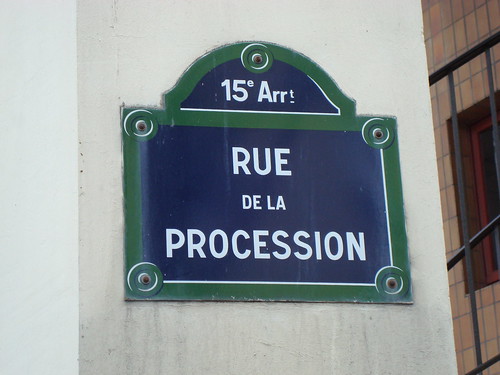
First clue: a street sign. But like any street name, it does not necessarily indicate a present state. The designation indicates only that there have been at one time religious activity around this axis. Information taken, it meant a transition from regular old processions of the parish (Saint-Lambert de Vaugirard?). However, the very name of the street included some Christian culture in public space.

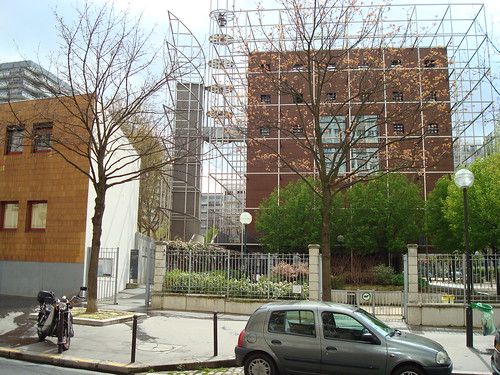
Advancing in the street, one passes close to a new building, contemporary architecture whose appearance does not think of an apartment building, but nothing seems specify at first glance function.

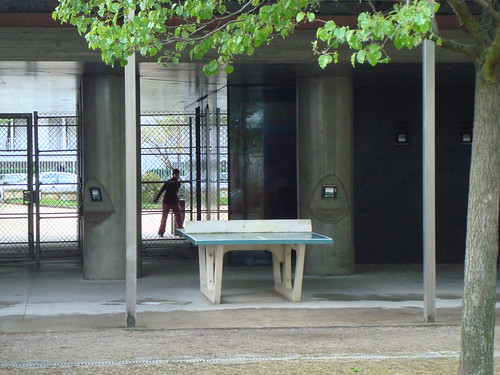
At the foot of the building, square. The ground floor is completely open, no walls, just a couple of concrete pillars, providing shelter for pedestrians and the opportunity to play table tennis.

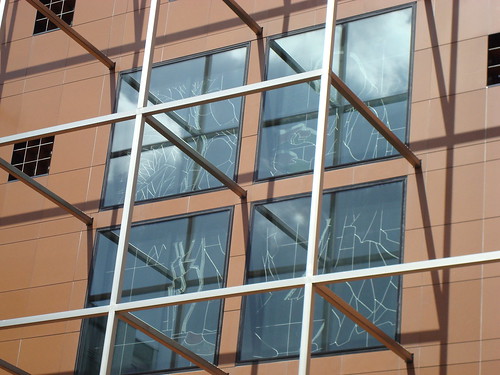
The large windows of the building suggest a work of art more visible from the inside. Maybe the stained glass?

The small metal tower houses the bells suggesting that it is a bell tower.

CLOCHER, SUBST. masc.

A. Construction shaped tower that surmounts a church or rises nearby, which houses the bells.
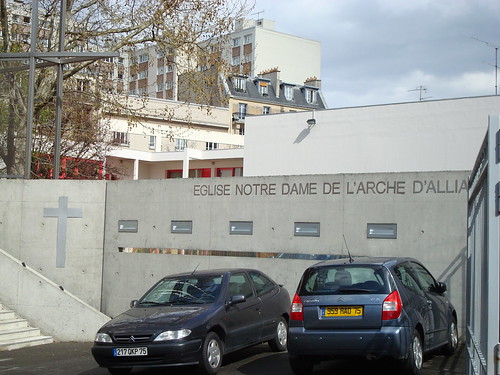
The vision of a tower directly refers to the presence of a church. The building in question would be a church.


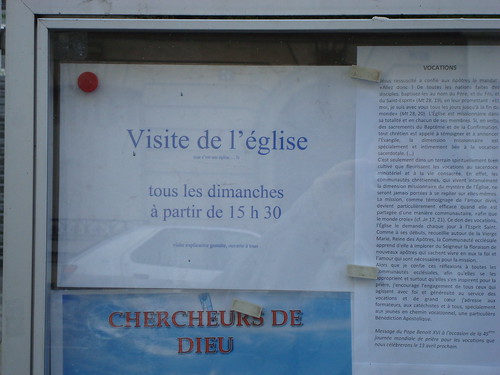
Confirmation: entry located in another street, there is the inscription: "Church of Our Lady of the Ark of the Covenant "and on the billboard, we announce the opportunity to visit the church.


The identification exercise presented here may seem winded. Yet it gathers the steps of the perception of religion in this Parisian street. The building, recently built, falls outside the standard to images of older churches. The observer must look for clues to read the urban landscape before him. Furthermore the word "church" at the entrance or on the outdoor billboard (note however that few churches on the walls of which are mentioned they are churches), the perception becomes more clear From the moment we fix the steeple. Because this is the steeple, in reading the landscape and one that has had to make daily, informs us of the presence of a church. Without the tower, the church would probably be invisible.
It touches on the tower's primary function: to make visible the church. From a sound point of view of course but also from a visual standpoint. The tower is in fact normally exceed what other homes or buildings and can locate where the church in the urban fabric. It is the outward sign that registers a religion (Catholic, but here it could be Orthodox) in the landscape.
As for the church steeple, minaret plays a major role in the inclusion of Islam in the landscape. As the steeple, so it makes visible and audible visual mosque and it is reasonable to think that in the evolution of Muslim religious architecture minaret, like the tower, will be another key to identifying the building as a mosque in the coming decades. Prohibit the construction of minarets, this is not only a negative signal initiated to Muslim citizens, it is indeed clear the landscape of Islam, making it invisible to the passer and in fact deny the possible integration ...

Friday, December 4, 2009

Does Cranberry Juice Makes Poop Red

The hen EHESS between realities and contemporary interpretations

Photo of the Facebook profile of the hen EHESS

To finish the week just slightly, I thought I could tackle a subject that if we were not in December, looks like an April Fool when the situation is real. For several weeks, almost two months, a red hen has indeed taken up residence in the garden of 54 Boulevard Raspail, behind the building housing the EHESS and Maison des Sciences de l'Homme. Check mysteriously - Nobody really knows how or why she moved there, it occupies part of the discussion of corridors and cafes, especially since she regularly visits the area around the cafeteria. Nourished by each other, it took some stout. Modern, it is now featured on Facebook, where a well-intentioned spirit has created an account entitled "The hen EHESS . His public profile even tells us she is a fan of Pierre Bourdieu, Walter Benjamin, Slavoj Zizek and Maw Weber. But beware, the animal is selective and does not accept all-comers as a friend! So I expect it always accepts me among knowledge ;-)...
But what makes this chicken in the middle of the sixth arrondissement of Paris, you say? The answer is that ultimately, we do not know. One can certainly think that the situation will not ask researchers EHESS. One can indeed imagine a range of interpretations depending on the specialty of each. Nietzsche said it well: "there are no facts, only interpretations." The fact seems to exist here, the presence of this pool, but the interpretations might be able to quickly reach the over-interpretation which is the main risk watching for any work in the social sciences.
In the meantime, here are some possible lines of thought and open your possible comments and your own interpretations, of course ...

For historians, the presence of fowls would have no other purpose than to remind us of the famous question of the chicken and egg: which comes first? which is causing the other? We wish to recall, however, that Marc Bloch, in his historical profession we warned against the temptation to own tribe of historians, that of the idol of origins, the desire to link an inaccessible origin knowledge with a period or a present given and explain them through this link.
Let us beware of the chicken so we came to try and move to another field.

For some economists, this pool could be the vanguard of an eventual transition to the expanded jurisdiction of the Ecole des Hautes Etudes en Sciences Sociales. EHESS must indeed think, like all French universities, it passes a new statute granting financial autonomy. Anticipating the autonomous management of its finances, this chicken would be the first element of a future food self-production (meat and in eggs) to reduce production costs of the canteen.

For sociologists, the presence of the Red Hen in the heart of Paris is undoubtedly a sign of urbanization is booming: not content to leave the city to the hinterland, urban residents now introduce campaign within the capital ...

But anthropologists do not share the views of their colleagues. For them, we would be here with feeding and storage of poultry for an upcoming voodoo sacrifice and thus protect the EHESS bellicose intentions threatening ... It however, could be a rite of thanksgiving for the proper evaluation of the school last spring or the preparation of a sacrifice for the success of the move next summer.

For their part, philosophers are concerned: do we not facing a thinly veiled criticism, comparing the EHESS for Kircher famous hen, poor hen who dared not go out of the chalk circle that we had traced around her?

For scholars of visual culture, it seems clear that this is actually a participation the EHESS in the ongoing debate over national identity. As everyone knows, the cockerel is the symbol of France ... But you will object, is a chicken, right? Absolutely, but it's a chicken processing rooster chicken could effectively symbolize gender as a national value!

Here we see the difficulty of reconciling disciplinary interpretations. For now, only conclude by telling us that this pool is there to provide us during a time of recreation. It is much ...


Tuesday, December 1, 2009

Bady Good Luck Messages

An invention of relics

The news went almost unnoticed last November 20: we found relics of Galilee (see photo-cons - AP). The announcement, very serious, was made by Paolo Galluzzi, director of the Museum of History of Science in Florence. The story seems trivial, yet it is comparable to most stories rediscovered relics even though in the case of Galileo, it is not a "saint" in the religious sense of the term (perhaps by cons grant him the status of "hero" or "martyr" of science if we wanted to draw a parallel).
A collector (anonymous) has in effect bought recently at an auction of items classified as "unidentified" in a beaker of the eighteenth century before realizing it was human bones . Investigation, whose details were not reported by the media, leading it to believe it would be two fingers and a tooth removed from his body Galilee in 1737, 95 years after his death upon transfer of his remains in the Basilica of Santa Croce in Florence. On this occasion another finger and a vertebra were also collected and preserved thereafter in museums of Florence and Padua. From 1737 to 1905, the two fingers and teeth were preserved by a family before we lose track of these relics. The recent acquisition of anonymous collector is a rediscovery of the relics disappeared for over a hundred years ... The pattern of transmission of these relics is as follows: sampling at a late transfer of the remains - stored in a private setting - disappearance of the relics - recurrence after authentication of an object initially unidentified. To close this scheme, adding that the relics will be exhibited in spring 2010 at the Museum of History of Science in Florence. Finally, the authenticity of these relics is affirmed through the scholarly authority, the museum director who reported to cut short any debate: "In light of considerable historical documentation, the authenticity of these items no doubt" .
Those who know the religious history will recognize this pattern in the conventional steps of the invention (within the meaning of "discovery") or the preservation of relics. The difference with what is known is probably the extreme contemporaneity of the event: it is not a rediscovery after a past moment of crisis (as a revolution or a war) that the historian reconstructs from its sources, but a fortuitous rediscovery in a context of both antique and scientist who place our eyes.
What has changed is perhaps the reaction to this rediscovery. If exposure is considered, the reactions of users have been few. The invention of the relics of Galileo is therefore conducted in a certain indifference. Those who respond are far from enthusiastic. Quite the contrary, skepticism prevails. It seemed interesting to note the different types of arguments for the rejection of these relics, but questioned their historical continuity. These arguments have been virtually set in the sixteenth century by Calvin in his famous treatise on relics (1543) in which he summarizes the arguments and radical humanists of his predecessors. His arguments are, in summary, three types: theological (the worship of relics is idolatry), pragmatic (the relics are usually wrong) and moral (the relic is a piece of corpse). In the case of Galileo, the theological argument can not be used because there is no a priori not worship. However, we note that the debate sometimes slips the role of Galileo in the history of science, the "holy" / "Heroes" / "martyr" became an example and not an idol. The other two types of arguments are cons prominently in the reviews. I give you some examples of reactions, classified by type of argument.

True or false?
As Calvin wrote, "is a notorious fact that most of the relics that shows everywhere are false and have been put forward by scoffers who have shamelessly abused the poor world." This declaration marked the critical relics until today and Readers of information are also inhabited:
"How to be certain that these relics come from Galilee? Even his DNA can not be compared with anything. This is nonsense and in any case, very ugly "(a reader of the New Gazette - Belgium)
" How do I know ????? The police had his fingerprints or they have retrieved the records of the dentist ??????" (A reader of Figaro - France)
sign of the times, where the impossible Calvin advanced authentication or the multiplicity of historical relics, the argument here police (DNA fingerprinting or dental) that predominates ...

Relics and corpse
"It was the Office of the Christians to leave the bodies of the saints in their tomb in obedience to the sentence that all men are universal and return powder powder" , says Calvin, returning the relic in the tomb as the ashes of a deceased. Two and a half centuries later, the revolution in its dechristianisers episode, she also saw some of his players to return the relic to his morbid state. In April 1794, a former constitutional priest denounces the district of Toulouse practices of the municipality of Pibrac: "You know, probably a corpse named St. Germaine, exists in the church of this village and that the body is regarded as holy." Later he calls it even "rotting body" (quoted in Stephen Baciocchi and Dominique Julia, "Relics and the French Revolution," in Modern Relics , p. 551-552). In some cities during the Revolution, the relics are buried elsewhere, like those of St. Remi in Reims. The religious sentiment of Calvin, through the Revolution, the development of gaze on the relic desecration continues today as the trade relics and equipment is prohibited on eBay, Regulation stating that "the sale of organs, tissues, cells, blood and any other product on the human body is strictly prohibited on the site. At a time when the relic is again part of the human body, users do not deprive themselves to argue their disgust at the forthcoming exhibition of the relics of Galilee
"Personally, I find it hard to understand how can get there. Who would want pieces of corpses? Regardless of who was the body to the limit, I find it so morbid and without any interest. As much, I can understand the grave robbers that retrieves valuables, as there, is beyond me ... "(a participant in www.forum-religion.org )
" The way we dug and displays the body is really disgusting. Are these people would like to be dug up and their parents that expose them? "(A participant in newsvine.com )
" My God, it is morbid, primitive and inexcusable ... Gather all its pieces and stop it ... Give him the respect that we all want for ourselves in death. Bury him ... The whole ... In one place ... And leave him alone "(another speaker on newsvine.com )
"Some of the ideas of Galileo are eternal truths. All body parts should be buried deteriorated. If one of these institutions are bending to the curiosity of the public bad taste was a bit of class and decency She would call these body parts in the tomb of Galilee "(another speaker on newsvine.com )
From the religious argument of Calvin and anticlerical polemic revolutionaries, the question of the relationship between relics and corpses therefore moved to the area of sensitivity. The relic is humanized here, it is in the eyes those who are responding really a piece of corpse - the argument here involving no other ulterior motive - and that they are unbearable. Thus the comparison between relics and ashes, so to say well it was already present in Calvin, does not seem necessarily fall under the same logic.